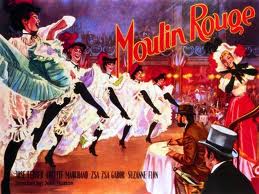
Let your mind wander and fantasize with me for a brief moment. We are standing in a noisy cabaret. The gas lamps are flickering from the dense smoke wafting in the hot, steamy air. There is music reverberating in every corner of the room from the pulsating rhythms of Jacques Offenbach’s melodies. On the stage we see a line of dancers with ruffled, red skirts of satin and lace exposing one outstretched, gyrating leg in the air, while rhythmically bouncing on the other leg to keep pace with the rollicking cancan music. The tops of their heaving bosoms are accentuated by corseted waists and are partially exposed in low cut white silk blouses. Perspiration is shimmering on their bare shoulders. Their lungs are screaming for air as the music’s pace quickens.
Outside the cabaret walls, on the Boulevard de Clichy, resting at the base of Monmatre (a hill thirty meters high in Paris) it is cold and dark but inside it is bright and steaming hot from the crowd of people. The atmosphere is carefree and festive in the newest dancehall in the Pigalle section of Paris, France. It is a time for gaiety and celebration in an era that will later be called—La Belle Époque! Science and technology are making life easier for everyone with the spreading of electricity across France. The New Year offers great hopes for prosperity in a Europe at peace.

We are standing on the crowded dance floor of the legendary Moulin Rouge. The date is December 31, 1889. It is the inaugural year of the notorious cabaret frequented by the post- impressionist artist, Toulouse-Lautrec. The Champagne from the House of Clicquot is flowing and bubbling over in the glasses of the revelers. In the ballroom lusty, perfumed woman, with highlighted cheeks of rouge, mingle in the crowd adding an air of excitement to the festivities. It is an eclectic gathering of upper class, waist coated nouveau bourgeoisie and prostitutes mingling and rollicking together. Off in a far corner of the room the diminutive Toulouse-Lautrec sits quietly sketching the festivities on a sheet of paper with a charcoal stick. The time nears, the excitement crescendos and erupts in a mass chorus counting down to midnight,
“Dix, neuf, huit, sept, six, cinq, quatre, trois, deux…Bonne Année!”
The Royal Wine
Champagne bespeaks gaiety, opulence and frivolity. The tiny bubbles, long held captive in bottles frivolously dance their way to the tops of elegant, slim flutes while beckoning the holder to come and play. “Leave your troubles behind for another time.” They seem to say. “Indulge yourself in my richness.
I am not an ordinary wine.
I am Champagne!
Champagne is the royalty of wine. To evolve into Champagne, wine undergoes two fermentation processes. The first fermentation takes place in wooden barrels as ordinary wine, and then this still (non-effervescent) wine is transferred to bottles made of thick glass that will transform it from wine to Champagne! The transformation process that is the genesis of Champagne is called Methode Champenoise. It is in this old, time consuming process and the origin of the grapes that makes Champagne different from all other sparkling wines.

In the second fermentation, Methode Champenoise or the Traditional Methode as it is also known; sugar and yeast are added to the still wine to activate the second fermentation. The bottle is corked to prevent the carbon dioxide from escaping. The dead yeast or sediment that forms in the bottle is slowly maneuvered down onto the cork and into the bottle’s neck by a process called riddling (remuage in France). This process consists of inverting the bottles, cork down, on a forty-five degree angle in a specially built rack (pupitre) that was invented by Madame Clicquot in the early eighteen hundreds. Then every three to four days a Remuer (a skilled craftsman) gives the bottle a slight lift and a small turn, by hand, dropping the bottle in the rack with a slight jolt, and then gradually increasing the angle of the tilt downward by lowering the top of the pupitre. This laborious process continues for about six to eight weeks until the sediment is completely collected on the cork and the bottle is upside down. At this point the cork is removed, releasing the collected sediment (disgorgement) and what remains in the bottle is the result of the skillful Remuer’s loving care— crystal clear, sparkling, flavorful Champagne. The bottle is topped-off with a combination of wine, brandy and or sugar, depending on the desired level of sweetness and finally resealed with a new cork and wire.

The use of the name “Champagne” by sparkling wine producers not located in the province of Champagne has, for a very long time been a contentious legal battle among winemakers outside of France. Due to Champagne’s ever increasing popularity and its reputation for painstaking quality it is only natural that other sparkling wines, which are made in the same Traditional Methode, would want to be named Champagne. This name however, denotes more than just a fermentation process; it is also the province in France where the grapes are grown. As I have written many times before in this column and in others, in Europe it is all about the soil—terroir. To the European winemaker the soil plays an integral role in determining the characteristics of the wine along with the winemaking method. Setting international treaties aside for a moment; the question begs to be answered. “If a wine is associated with the place the grapes are grown, then how can wines made from grapes grown elsewhere use the same name?”

In Spain for example, sparkling wine made in the Traditional Methode, is called Cava (see my July 2008 article in the Tubac Villager). Other provinces of France, such as Burgundy and Alsace also make sparkling wine in the Traditional Methode but call them Crémant de Bourgogne and Crémant d’Alsace respectively. The reason is simple—the wine is not from the province of Champagne.
Sparkling wines made in the United States are commonly labeled “Champagne”. The reasons for this are many. For the most part the right to use the name “Champagne” was codified in the Treaty of Versailles, after World War I. The Congress of the Unites States did not ratify the treaty and we consider ourselves free to use the name “Champagne” for our sparkling wine. From my perspective, wine grown in the province of Champagne, made in the Traditional Methode, is “Champagne”. All the other sparkling wines that are made in the Traditional Methode, no matter how good they may be, are simply not Champagne. They are like Champagne, made the same way as Champagne but not Champagne.
Having Champagne is always a memorable experience; whether it is welcoming in a new year, celebrating a joyous event, accompanying food or just sipping it quietly by oneself, its memory lingers. Champagne is so distinctive that everything associated with it becomes memorable.
Sommelier Champagne Selections
Over the years I have enjoyed some of the finest Champagnes produced. Two that come to mind are
Cristal and Gosset Grand Reserve. My memory of Cristal is a light, bone dry, crystal clear, shimmering Champagne, gently dancing on my tongue. My mouth waters with the thought of Cristal and caviar.
The mention of Gosset brings back memories of drinking the NV (non vintage) Brut, for the first time, with lunch in a little French boulangerier (bakery) in the village of Epernay that is home to the House of Gosset. Having Champagne with a simple lunch in a French boulangerier may sound terribly decadent but logically, what else would anyone have in the Champagne producing province of France. The Gosset, NV Brut is not as dry as Cristal but still very delicate with a bit more yeast flavors on the palate. The Gosset Grand Reserve is a bit drier than the NV Brut and more delicate but still not as dry as Cristal.
My favorite though is
Ruinart, Blanc de Blanc. I will always be indebted to my generous daughter-in-law for making me a gift of this incredibly tasty bubbly. The House of Ruinart is the oldest, continuously producing Champagne house in Reims, France. The Blanc de Blanc is one hundred percent Chardonnay. Each mouthful titillates the palate with tiny effervescence and is full of rich yeast and wet straw aromas. It is a savory, full bodied Champagne that energizes the taste buds with more yeast richness and hints of citrus. Each sip is seductive and inviting.
Gosset and Ruinart are available in wines stores throughout Arizona and usually sell for more than fifty dollars each. As a less expensive American made alternative, I recommend any vintage version of Gruet, Blanc De Blanc from New Mexico (yes, New Mexico). The Gruet family has been producing Champagne in the small town of Bethon, France since 1952. In 1984 Gilbert Gruet’s son Laurent and his sister, Nathalie started making Sparkling Wine, using the Traditional Methode in Albuquerque, New Mexico. As a French family they appropriately do not call their sparkling wine Champagne. It is produced in the Method Champenoise and is a very good value for twenty-five dollars.
Gruet’s Blanc De Blanc is made from Chardonnay, with crisp citrus flavors and is moderately dry to the taste. It starts off a little harsh when the bottle is first opened but softens nicely, after about fifteen minutes of breathing time in the bottle. The bubbles are uniformly tight to delight and reward the budget conscious with a very good value for their dollar spent. Gruet is conveniently available locally.
This year as the clock ticks down to the New Year, lift your glasses with me and let us return to our fantasy celebration at the Moulin Rouge. Come with me where the Champagne is flowing and memories are being born. As we step inside we will hear, “Bienvenue à mon fard à joues de Moulin Rouge. Bonne Année!”
Bernard Berlin
 As our days turn warmer and warmer, lay down the red wines, set aside the whites and uncork the refreshing enthusiasm of a chilled bottle of sparkling white wine. Kid-wild, their effervescence dances to the tops of our glasses as carefree children frolicking on a trampoline. Titillating, tiny bubbles burst into the air, gently spraying a fine wet mist on our lips, alluring our senses with the promise of an uncommon wine experience.
 Although American sparkling wines legally bear the misleading label of “
 Sparkling wines are also great to have as an aperitif before dinner. Unlike martinis or cocktails made with liquor, which dampen our taste buds, sparkling wines invigorate them. Any of these sprightly wines become elegant aperitifs with panache, by adding a splash of a liqueur or fresh fruit to the glass. An ounce or two of Crème de Cassis in a glass of Crémant de Bourgogne creates a flavor-rich Kir Royal. The Italian sparkling wine, Prosecco is the foundation for the famed “Bellini” that originated in Harry’s Bar in